EWG's Healthy Home Checklist
http://www.ewg.org/files/ewg-hht-checkilist.pdf
Monday, April 12, 2010
Sunday, April 11, 2010
Family's nine-year ordeal in toxic home
Family's nine-year ordeal in toxic home
http://www.nzherald.co.nz/nz/news/article.cfm?c_id=1&objectid=10637807
"Joseph Chee came to New Zealand from Malaysia with his wife and children looking forward to a new start."
http://www.nzherald.co.nz/nz/news/article.cfm?c_id=1&objectid=10637807
"Joseph Chee came to New Zealand from Malaysia with his wife and children looking forward to a new start."


Child Sets Self on Fire
Child Sets Self on Fire
http://www.newschannel9.com/news/child-990289-clark-perfume.html
"A four-year-old child set himself on fire Sunday morning playing with a bottle of flammable perfume and a lighter."
http://www.newschannel9.com/news/child-990289-clark-perfume.html
"A four-year-old child set himself on fire Sunday morning playing with a bottle of flammable perfume and a lighter."
'Electronic Nose' Sniffs Out Asthma
'Electronic Nose' Sniffs Out Asthma
http://www.cbc.ca/cp/HealthScout/100408/6040804AU.html
"The device works by identifying volatile organic compounds (VOCs) in exhaled breath. These VOCs produce a unique smell print for each individual and specific patterns are seen in people with asthma."
http://www.cbc.ca/cp/HealthScout/100408/6040804AU.html
"The device works by identifying volatile organic compounds (VOCs) in exhaled breath. These VOCs produce a unique smell print for each individual and specific patterns are seen in people with asthma."
MCS Awareness Month - May 2010
Multiple chemical sensitivity (MCS) affects over 48 million men, women, and
children of all races. Even though MCS is of widespread epidemic
prevalence, public awareness of the toxicity of common environmental insults
and ways to manage and accommodate MCS remains limited. Multiple Chemical
Sensitivity Awareness Month, May 2010, bestows upon us a great opportunity
to work towards increased public awareness of MCS.
children of all races. Even though MCS is of widespread epidemic
prevalence, public awareness of the toxicity of common environmental insults
and ways to manage and accommodate MCS remains limited. Multiple Chemical
Sensitivity Awareness Month, May 2010, bestows upon us a great opportunity
to work towards increased public awareness of MCS.
Organizations around the world have put forth great effort to establish May
of each year as either Multiple Chemical Sensitivity Awareness Month or
Toxic Injury Awareness Month. Many are working to improve awareness and
appropriate healthcare around the world. Activities are organized around
the month of May and continue throughout the year. MCS America plays a
special role during this time and is committed to promoting awareness of
toxic chemicals which may cause MCS and trigger reactions in those already
injured by toxic chemicals.
This entire month of May is dedicated to planning for individuals and
organizations in the U.S. to hold local events during Multiple Chemical
Sensitivity Awareness Month and beyond. You will find numerous ideas for
promoting awareness, educating others, increasing recognition, and planning
community events. There are many editable sample materials which may be
downloaded and used locally.
Thousands of multiple chemical sensitivity awareness events are expected to
take place across the United States this May. MCS America provides an MCS
Event Planning Kit at
http://mcs-america.org/MCSAwarenessMonthEventPlanningKit2010.pdf to help you
plan both small and large awareness events. MCS America can help publicize
your event on news feeds, blogs, newspapers, our newsletter, and other
venues. Submit your event to admin@mcs-america.org. I value your feedback on
the usefulness of the sample materials and welcome suggestions for future
materials.
I would like to thank you for any and all efforts towards increased
awareness in your locality. I look forward to assisting you in any way I
can. Working together, we can help America to take control of toxic
chemicals and eradicate multiple chemical sensitivity.
Lourdes
Fragrance Fact Sheet

This is a simple and to the point fact sheet about fragrance that can be used and posted during MCS Awareness month and beyond. You can download a printable copy from http://mcs-america.org/fragrancefactsheet.pdf.
MCS Fact Sheet
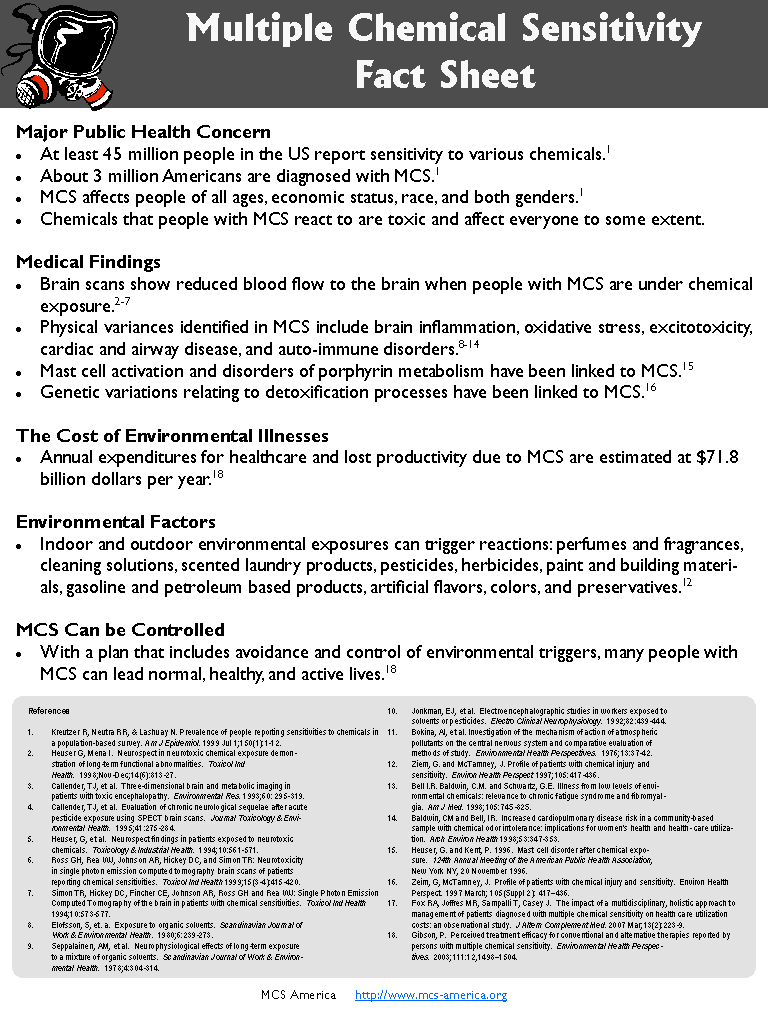
This is a simple and to the point fact sheet about MCS that can be used and posted during MCS Awareness month and beyond. You can download a printable copy from http://mcs-america.org/mcsfactsheet.pdf.
EMR Fact Sheet

This is a simple and to the point fact sheet about EMR that can be used and posted during EMR Awareness month and beyond. You can download a printable copy from http://mcs-america.org/emffactsheet.pdf.
Saturday, April 10, 2010
Up to 250,000 Gulf War veterans have 'unexplained medical symptoms'
Up to 250,000 Gulf War veterans have 'unexplained medical symptoms'
http://www.washingtonpost.com/wp-dyn/content/article/2010/04/09/AR2010040904712.html
http://www.washingtonpost.com/wp-dyn/content/article/2010/04/09/AR2010040904712.html
"As many as 250,000 veterans of the first Gulf War "have persistent unexplained medical symptoms" whose cause may never be found, although genetic testing and functional brain imaging may eventually shed some light on the problem."
Helena Chemical Company wins case against community activist
Helena Chemical Company wins case against community activist
http://newmexicoindependent.com/51155/helena-chemical-company-wins-case-against-community-activist
http://newmexicoindependent.com/51155/helena-chemical-company-wins-case-against-community-activist
"Uribe ordered to pay $75k in punitive damages
Wednesday night, a jury found a southern New Mexico activist guilty of defamation and harassment against a chemical company."
Household detergents, shampoos may form harmful substance in waste water
Household detergents, shampoos may form harmful substance in waste water
http://www.eurekalert.org/pub_releases/2010-04/acs-hds040710.php
"Scientists are reporting evidence that certain ingredients in shampoo, detergents and other household cleaning agents may be a source of precursor materials for formation of a suspected cancer-causing contaminant in water supplies that receive water from sewage treatment plants. The study sheds new light on possible environmental sources of this poorly understood water contaminant, called NDMA, which is of ongoing concern to health officials. Their study is in ACS' Environmental Science & Technology, a semi-monthly journal."
http://www.eurekalert.org/pub_releases/2010-04/acs-hds040710.php
"Scientists are reporting evidence that certain ingredients in shampoo, detergents and other household cleaning agents may be a source of precursor materials for formation of a suspected cancer-causing contaminant in water supplies that receive water from sewage treatment plants. The study sheds new light on possible environmental sources of this poorly understood water contaminant, called NDMA, which is of ongoing concern to health officials. Their study is in ACS' Environmental Science & Technology, a semi-monthly journal."
Legislature tackles new laws to reduce toxic materials
Legislature tackles new laws to reduce toxic materials
http://seattletimes.nwsource.com/html/ecoconsumer/2011551834_ecoconsumer10m.html
"For the Washington Legislature this session, taking care of business included asking business to take care of the environment. Gov. Chris Gregoire signed three major green consumer laws passed by the Legislature, each of them requiring the private sector to assume most of the costs and responsibilities."
http://seattletimes.nwsource.com/html/ecoconsumer/2011551834_ecoconsumer10m.html
"For the Washington Legislature this session, taking care of business included asking business to take care of the environment. Gov. Chris Gregoire signed three major green consumer laws passed by the Legislature, each of them requiring the private sector to assume most of the costs and responsibilities."
Poisoning by prescription drugs on the rise
Poisoning by prescription drugs on the rise
New study indicates US hospitalizations for poisoning by opioids, sedatives and tranquilizers increased 65 percent from 1999-2006
http://www.eurekalert.org/pub_releases/2010-04/ehs-pbp040110.php
"San Diego, CA, April 6, 2010 – Poisoning is now the second leading cause of unintentional injury death in the U.S. While several recent high-profile Hollywood celebrity cases have brought the problem to public attention, the rates of unintentional poisoning deaths have been on the rise for more than 15 years, and in fact, unintentional poisoning has surpassed motor vehicle crashes as the leading cause of unintentional injury death among people 35-54 years of age. In a study published in the May issue of the American Journal of Preventive Medicine, researchers found that hospitalizations for poisoning by prescription opioids, sedatives and tranquilizers in the U.S. have increased by 65% from 1999 to 2006."
New study indicates US hospitalizations for poisoning by opioids, sedatives and tranquilizers increased 65 percent from 1999-2006
http://www.eurekalert.org/pub_releases/2010-04/ehs-pbp040110.php
"San Diego, CA, April 6, 2010 – Poisoning is now the second leading cause of unintentional injury death in the U.S. While several recent high-profile Hollywood celebrity cases have brought the problem to public attention, the rates of unintentional poisoning deaths have been on the rise for more than 15 years, and in fact, unintentional poisoning has surpassed motor vehicle crashes as the leading cause of unintentional injury death among people 35-54 years of age. In a study published in the May issue of the American Journal of Preventive Medicine, researchers found that hospitalizations for poisoning by prescription opioids, sedatives and tranquilizers in the U.S. have increased by 65% from 1999 to 2006."
Medicine residues may threaten fish reproduction
Medicine residues may threaten fish reproduction
http://www.sahlgrenska.gu.se/english/news_and_events/news/News_Detail/Medicine_residues_may_threaten_fish_reproduction.cid925382
"Researchers at Umeå University and the Sahlgrenska Academy at the University of Gothenburg have discovered that traces of many medicines can be found in fish that have been swimming in treated waste water. One such medicine, the hormone levonorgestrel, was found in higher concentrations in the blood of fish than in women who take the contraceptive pill. Elevated levels of this hormone can lead to infertility in fish."
http://www.sahlgrenska.gu.se/english/news_and_events/news/News_Detail/Medicine_residues_may_threaten_fish_reproduction.cid925382
"Researchers at Umeå University and the Sahlgrenska Academy at the University of Gothenburg have discovered that traces of many medicines can be found in fish that have been swimming in treated waste water. One such medicine, the hormone levonorgestrel, was found in higher concentrations in the blood of fish than in women who take the contraceptive pill. Elevated levels of this hormone can lead to infertility in fish."
Cell Phones that Detect Toxic Chemicals
Cell Phones that Detect Toxic Chemicals
http://www.emaxhealth.com/1275/cell-phones-detect-toxic-chemicals.html
"If the Department of Homeland Security has its way, cell phones in the near future will be equipped with an inexpensive chip that can detect deadly toxic chemicals. The department's Science and Technology (S&T) Directorate has been working on the initiative, called Cell-All."
http://www.emaxhealth.com/1275/cell-phones-detect-toxic-chemicals.html
"If the Department of Homeland Security has its way, cell phones in the near future will be equipped with an inexpensive chip that can detect deadly toxic chemicals. The department's Science and Technology (S&T) Directorate has been working on the initiative, called Cell-All."
Association between indoor exposure to semi-volatile organic compounds and building-related symptoms among the occupants of residential dwellings.
Association between indoor exposure to semi-volatile organic compounds and building-related symptoms among the occupants of residential dwellings.
Kanazawa A, Saito I, Araki A, Takeda M, Ma M, Saijo Y, Kishi R.
Indoor Air. 2010 Feb;20(1):72-84. Epub 2009 Sep 30.
Indoor Air. 2010 Feb;20(1):72-84. Epub 2009 Sep 30.
Department of Public Health Sciences, Hokkaido University Graduate School of Medicine, Sapporo, Japan.
Abstract
The aim of this study was to evaluate the levels of semi-volatile compounds (SVOCs) in residential detached houses in Sapporo, Japan, and whether exposure to these SVOCs was associated with the development of building-related symptoms named 'sick house syndrome' (SHS). The definition of SHS is fundamentally the same as that of the sick building syndrome (SBS). The presence of symptoms of SHS was evaluated using a validated self-administered questionnaire. Surveys and samplings of air and house dust in 41 dwellings were performed from October 2006 to January 2007, and 134 occupants responded to questionnaires. Samples were analyzed to quantify the concentrations of eight plasticizers, eleven phosphate triester flame retardants, two alkyl phenols used as anti-oxidants, and one organochlorine synergist called s-421, by gas chromatography-mass spectrometry and gas chromatography-flame photometry. The compounds frequently detected were di-n-butylphthalate, di(2-ethylhexyl)phthalate (DEHP), and dibutylhydroxytoluene in air, and DEHP and tris(2-butoxyethyl)phosphate (TBEP) in dust. Tributylphosphate was strongly and directly associated with mucosal symptoms of SHS; s-421 was also directly associated with mucosal symptoms of SHS. On the contrary, some chemicals such as diethylphthalate and TBEP were inversely associated with SHS. In future studies, we plan to assess these associations in a larger population. PRACTICAL IMPLICATIONS: This study suggests that it may be possible to reduce building-related symptoms by altering exposure to certain SVOCs, such as tributylphosphate commonly found in ceiling and wall coverings and s-421 used as a synergist for pyrethroids. The association between SHS and s-421 suggested that use of pyrethroid insecticides could elicit symptoms of SHS. However, further studies are necessary to test the associations observed in the present study and to examine whether the SVOCs associated with symptoms are causative agents or simply surrogates for some other factor that is causing the symptoms.
PMID: 20028434 [PubMed - indexed for MEDLINE]
Evaluation of an air sampling technique for assessing low-level volatile organic compounds in indoor environments.
Evaluation of an air sampling technique for assessing low-level volatile organic compounds in indoor environments.
LeBouf RF, Casteel C, Rossner A.
J Air Waste Manag Assoc. 2010 Feb;60(2):156-62.
Environmental Science and Engineering, Clarkson University, Potsdam, NY, USA.
Abstract
Measuring trace levels of volatile organic compounds (VOCs) in indoor environments is important for the characterization of occupant exposures. The ability to quickly collect air samples at relatively low costs per sample can increase the number of samples that can be collected and thus improve the overall assessment of potential exposures. The specific goal of this paper is to evaluate the accuracy and precision of evacuated glass bottle air samplers (Entech Bottle-Vacs) to collect representative VOC samples at part-per-billion concentrations in indoor environments. Laboratory generated data are also included to validate the precision and accuracy of the method. Multiple Bottle-Vacs in 10 residences in northern New York over 18 different sampling periods were used to collect whole-air VOC samples. Percent relative standard deviations ranged from 1.2 to 20.3% with a median of 8.8% for the 21 compounds analyzed in each Bottle-Vac. Two sampling techniques were used: around the valve (ATV) and through the valve (TTV). Linear regressions of ATV and TTV sample collection into the Bottle-Vacs show that these two sampling techniques are reproducible. Paired t test results show that ATV sampling is more reproducible than TTV; ATV paired samples were statistically the same 100% of the time whereas TTV paired samples were statistically the same 76.9% of the time. ATV sampling of low-level VOCs in indoor built environments is a reproducible chemical sampling technique that could be used by building occupants as a quick and inexpensive means of area sampling.
PMID: 20222528 [PubMed - indexed for MEDLINE]
Who's in Charge of Children's Environmental Health at School?
Who's in Charge of Children's Environmental Health at School?
Paulson J, Barnett C.
New Solut. 2010;20(1):3-23.
Abstract
Children spend many hours each week in and around school buildings. Their
short- and long-term health outcomes and ability to learn are affected by
numerous environmental factors related to the school buildings, the school
grounds, the school transportation system, and the use of various products
and materials in and around the school. Many school buildings are old, and
they-and even newer buildings-can contain multiple environmental health
hazards. While some districts self-report they have environmental health
policies in place, no independent verification of these policies or their
quality exists. Teachers and other staff, but not children who are more
vulnerable to hazards than adults, are afforded some protections from
hazards by Occupational Safety and Health Administration (OSHA) regulations,
by their employment contracts, or through adult occupational health
services. Major environmental problems include: indoor air quality,
lighting, pests and pesticides, heavy metals and chemical management issues,
renovation of occupied buildings, noise, and cleaning processes and
products. No agency at the federal or state levels is charged with ensuring
children's health and safety in and around school buildings. No systematic
means exists for collecting data about exposures which occur in the school
setting. Recommendations are made for dealing with issues of data
collection, federal actions, state and local actions, and for building the
capacity of the Environmental Protection Agency and the Centers for Disease
Control and Prevention-designated and funded Pediatric Environmental Health
Specialty Units (PEHSU) in responding to and evaluating risks to children's
environmental health in schools.
PMID: 20359989 [PubMed - in process]
Cytotoxicity and genotoxicity in human lung epithelial A549 cells caused by airborne volatile organic compounds emitted from pine wood and oriented strand boards.
Cytotoxicity and genotoxicity in human lung epithelial A549 cells caused by airborne volatile organic compounds emitted from pine wood and oriented strand boards.
Gminski R, Tang T, Mersch-Sundermann V.
Toxicol Lett. 2010 Mar 30. [Epub ahead of print]
Toxicol Lett. 2010 Mar 30. [Epub ahead of print]
Institute of Environmental Medicine and Hospital Epidemiology, Department of Environmental Health Sciences, University Medical Center, Breisacher Strasse 115b, D-79106 Freiburg, Germany.
Abstract
Due to the massive reduction of air-change rates in modern, energy-saving houses and dwellings, the contribution of volatile organic compounds (VOCs) emissions from wood-based materials to indoor air quality has become increasingly important. To evaluate toxicity of VOC mixtures typically emitted from pine wood and oriented strand boards (OSB) and their main constituents (selected terpenes and aldehydes), cytotoxicity and genotoxicity were investigated in human A549 lung cells. To facilitate exposure directly via gas phase, a 200 L emission chamber was combined with a Vitrocell(R) exposure system. VOC exposure concentrations were measured by GC/MSD. Biological effects were determined after an exposure time of 1h by measuring cytotoxicity (erythrosine B staining) and genotoxicity (comet assay). Neither cytotoxic nor genotoxic effects were observed for VOC mixtures emitted from pine wood or OSB at loading factors of approximately 13m(2)/m(3) (worst case conditions) of the panels (with maximum VOC levels of about 80mg/m(3)) in comparison to clean air. While alpha-pinene and Delta(3)-carene did not induce toxic effects even at exposure concentrations of up to 1,800mg/m(3), and 600mg/m(3),respectively, hexanal showed a cytotoxic effect at 2,000mg/m3. The alpha,beta-unsaturated aldehydes 2-heptenal and 2-octenal caused genotoxic effects in concentrations exceeding 100mg/m(3) and 40mg/m(3), respectively. In conclusion, high concentrations of VOCs and VOC mixtures emitted from pine wood and OSB did not lead to adverse effects in A549 human lung cells even at concentrations 10(2)-10(5)-fold higher than those found in normal indoor air. Attention must be paid to mutagenic and possibly carcinogenic alpha,beta-unsaturated aldehydes. Copyright © 2010. Published by Elsevier Ireland Ltd.
PMID: 20362040 [PubMed - as supplied by publisher]
Pathophysiology and antioxidant status of patients with fibromyalgia.
Pathophysiology and antioxidant status of patients with fibromyalgia.
Iqbal R, Mughal MS, Arshad N, Arshad M.
Rheumatol Int. 2010 Apr 8. [Epub ahead of print]
Zoology Department, G. C. University, Lahore, 54000, Pakistan.
Abstract
Fibromyalgia syndrome (FMS) is characterized by systemic pain of unknown etiology and is often accompanied by various psychological symptoms. Research on different parameters in fibromyalgia (FM) indicates that multifactors are involved in its pathophysiology; such as genetic factors, substance P, serotonin, hypothalamic pituitary adrenal axis (HPA), muscles metabolic dysfunction, reactive oxygen species (ROS) and reactive nitrogen species (RNS). Oxidative stress has also been implicated in the pathophysiology of FM; therefore, supplementation with antioxidants may be important in modulation of the effects of ROS in patients with FM.
PMID: 20376669 [PubMed - as supplied by publisher]
United States Bankruptcy Court Case No. 09-51791, Barbara Ruthman Chapter 7 Debtor
United States Bankruptcy Court Case No. 09-51791, Barbara Ruthman Chapter 7 Debtor
http://www.leagle.com/unsecure/page.htm?shortname=inbco20100402578
http://www.leagle.com/unsecure/page.htm?shortname=inbco20100402578
"Home modifications that were necessary to meet an environmentally ill debtor's medical needs are exempt from bankruptcy as professionally prescribed health aids."
Friday, April 9, 2010
Gulf War Syndrome Is Real, But Causes Unclear: Report
Gulf War Syndrome Is Real, But Causes Unclear: Report
http://www.usnews.com/health/family-health/bones-joints-and-muscles/articles/2010/04/09/gulf-war-syndrome-is-real-but-causes-unclear-report_print.html
"IOM panel believes genetic studies may reveal why soldiers from 1991 conflict suffer today
FRIDAY, April 9 (HealthDay News) -- The cluster of symptoms experienced by some veterans of the 1991 Gulf War is a real disease, but its causes, treatment and potential cure remain unknown, concludes a new report from U.S. experts at the Institute of Medicine (IOM)."
http://www.usnews.com/health/family-health/bones-joints-and-muscles/articles/2010/04/09/gulf-war-syndrome-is-real-but-causes-unclear-report_print.html
"IOM panel believes genetic studies may reveal why soldiers from 1991 conflict suffer today
FRIDAY, April 9 (HealthDay News) -- The cluster of symptoms experienced by some veterans of the 1991 Gulf War is a real disease, but its causes, treatment and potential cure remain unknown, concludes a new report from U.S. experts at the Institute of Medicine (IOM)."
Scents and sensibility: The fragrant workplace
Scents and sensibility: The fragrant workplace
http://www.theglobeandmail.com/report-on-business/managing/weekend-workout/scents-and-sensibility-the-fragrant-workplace/article1529448/
"Is it time for you to flush your toilet water and swear off wearing scents at work? It isn't just that some people don't like the smells of the perfumes, colognes, body sprays and grooming products used by co-workers. Chemicals in the fragrances can trigger reactions ranging from headaches to heart palpitations in people who are sensitive to them, making it difficult for them to work effectively. While there are no Canadian laws regulating the wearing of fragrances in the workplace, a recent U.S. court ruling has put the issue back in the limelight. And a growing number of workplaces are voluntarily going scent-free. Should your workplace be next?"
http://www.theglobeandmail.com/report-on-business/managing/weekend-workout/scents-and-sensibility-the-fragrant-workplace/article1529448/
"Is it time for you to flush your toilet water and swear off wearing scents at work? It isn't just that some people don't like the smells of the perfumes, colognes, body sprays and grooming products used by co-workers. Chemicals in the fragrances can trigger reactions ranging from headaches to heart palpitations in people who are sensitive to them, making it difficult for them to work effectively. While there are no Canadian laws regulating the wearing of fragrances in the workplace, a recent U.S. court ruling has put the issue back in the limelight. And a growing number of workplaces are voluntarily going scent-free. Should your workplace be next?"
Dioxin exposure linked to infertility, difficulty conceiving.
Dioxin exposure linked to infertility, difficulty conceiving.
http://www.environmentalhealthnews.org/ehs/newscience/dioxin-linked-to-difficulty-conceiving/
Eskenazi, B, Mwarner, AR Marks, S Samuels, L Needham, P Brambilla and P Mocarelli. 2010. Serum dioxin concentrations and time to pregnancy. Epidemiology 21:224-231.
"Blood levels of the chemical dioxin are related to difficulty conceiving and higher rates of infertility in a group of Italian women."
http://www.environmentalhealthnews.org/ehs/newscience/dioxin-linked-to-difficulty-conceiving/
Eskenazi, B, Mwarner, AR Marks, S Samuels, L Needham, P Brambilla and P Mocarelli. 2010. Serum dioxin concentrations and time to pregnancy. Epidemiology 21:224-231.
"Blood levels of the chemical dioxin are related to difficulty conceiving and higher rates of infertility in a group of Italian women."
EPA Requires Contractors to Become Lead-Safe Certified
EPA Requires Contractors to Become Lead-Safe Certified
Agency expects more than 125,000 contractors to be trained by April 22 deadline
To locate local EPA-accredited RRP training providers using EPA's search tool:
http://cfpub.epa.gov/flpp/searchrrp_training.htm
Information on firm certification: http//:www.epa.gov/getleadsafe
More information on EPA's lead program: http://www.epa.gov/lead
Agency expects more than 125,000 contractors to be trained by April 22 deadline
To locate local EPA-accredited RRP training providers using EPA's search tool:
http://cfpub.epa.gov/flpp/searchrrp_training.htm
Information on firm certification: http//:www.epa.gov/getleadsafe
More information on EPA's lead program: http://www.epa.gov/lead
Community Environmental Health (EH) Assessment
Community Environmental Health (EH) Assessment
"Community EH assessments improve the environmental health decision-making process by strengthening community involvement so that public values and priorities are considered. This process can lead to real changes in communities and in addressing community needs."
Products for Environmental Health (EH) Programs
Products for Environmental Health (EH) Programs
"Toolkits and other resources developed by CDC EH grantees to help programs deliver EH services, improve EH capacity to respond to current and emerging health threats, and expand the science-base in environmental public health to improve public health practice."
Approaching a Perfect Storm: Responding to New Challenges Without Losing Critical Core Capacities
Approaching a Perfect Storm: Responding to New Challenges Without Losing Critical Core Capacities
http://www.cdc.gov/nceh/ehs
"Chris Kochtitzky discusses the need for successful environmental health (EH) systems to build on existing capabilities and deploy new skill sets toward both traditional and nontraditional challenges given today's economic and workforce realities. This column is in the April 2010 issue of the Journal of Environmental Health."
http://www.cdc.gov/nceh/ehs
"Chris Kochtitzky discusses the need for successful environmental health (EH) systems to build on existing capabilities and deploy new skill sets toward both traditional and nontraditional challenges given today's economic and workforce realities. This column is in the April 2010 issue of the Journal of Environmental Health."
Lung Function of 9/11 Rescuers Fell, Study Finds
Lung Function of 9/11 Rescuers Fell, Study Finds
http://www.nytimes.com/2010/04/08/nyregion/08lung.html?pagewanted=print
"Rescue workers exposed to thick clouds of dust after the attack on the World Trade Center had large drops in lung function lasting at least seven years, a study of nearly 13,000 workers has found."
http://www.nytimes.com/2010/04/08/nyregion/08lung.html?pagewanted=print
"Rescue workers exposed to thick clouds of dust after the attack on the World Trade Center had large drops in lung function lasting at least seven years, a study of nearly 13,000 workers has found."
Thursday, April 8, 2010
Chemical sensitivity: protecting yourself in the home
Chemical sensitivity: protecting yourself in the home
http://www.strausnews.com/articles/2010/04/08/sparta_independent/news/27.txt
"Chemical sensitivity — also termed toxic injury, environmental illness or sick building syndrome — refers to the repeated appearance of symptoms like headache, confusion, sleepiness, upset stomach, aching joints, or problems with ears, nose, and throat resulting from relatively low levels of exposure to chemicals. The good news is that the symptoms improve or disappear entirely when the triggering chemicals are removed."
http://www.strausnews.com/articles/2010/04/08/sparta_independent/news/27.txt
"Chemical sensitivity — also termed toxic injury, environmental illness or sick building syndrome — refers to the repeated appearance of symptoms like headache, confusion, sleepiness, upset stomach, aching joints, or problems with ears, nose, and throat resulting from relatively low levels of exposure to chemicals. The good news is that the symptoms improve or disappear entirely when the triggering chemicals are removed."
Subscribe to:
Posts (Atom)